
Abstract
The association between maternal occupational exposure during pregnancy and the subsequent development of asthma in their children has always been a matter of debate, and the results of cohort studies on this issue have been controversial. The current study is the first systematic review and meta-analysis aimed at evaluating the risk of developing subsequent asthma in children based on maternal occupational exposure during the gestation period. To retrieve eligible studies, an advanced literature search was performed up to August 10, 2023 from the following databases: PubMed, Scopus, and Google Scholars. The title and abstract of related articles were screened; hence, the full texts were reviewed. Data extraction was conducted; hence, the included articles were analyzed to assess the mention association. From a total of 10 cohort studies with a total record of 5372, it was found that there is no significant relationship between occupational exposure to asthmogenic during pregnancy and later asthma in children. The pooled odds ratio of asthmatic children in patients with maternal occupational exposure to asthmogenic during pregnancy was 1.03 (95% confidence interval, 0.97-1.09) I2= 13% p=0.62. It was concluded that there is no significant association between maternal occupational exposure and future asthma in children. However, future large-scale studies are required to support these results.
Keywords: Maternal occupational exposure, asthma, pregnancy, systematic review, meta-analysis
PRECIS: Investigating maternal occupational exposure during pregnancy and childhood asthma risk, our meta-analysis found no significant association, suggesting further research is needed for conclusive evidence.
Introduction
As stated by the World Health Organization, non-communicable diseases (NCD) claim the lives of 41 million individuals annually, accounting for 74% of global mortality(). Asthma, a prevalent NCD, imposes a substantial burden of morbidity and mortality. It is projected to impact almost 262 million individuals in 2019, resulting in 455,000 fatalities worldwide. Furthermore, it is the primary chronic disease among children on a global scale(). There are over 300 million people worldwide who are affected by asthma, and each day 1,000 people die because of asthma(, ). Moreover, young adults with asthma are 20 times more prone to develop chronic obstructive pulmonary disease().
The apparent epidemic of asthma and allergies recently seems to follow in the footsteps of economic development, the process of production, consumption, and urbanization(). Numerous studies have shed light on the connection between being exposed to various domestic and industrial ambient pollutants and experiencing bronchial wheezing(). Occupational exposures are responsible for 5-25% of all asthma cases among adult workers(-) by inducing the mechanism of immunoglobulin E (IgE)-mediated responses(). Promisingly, this number can be prevented if occupational exposures are obviated().
Potential risk factors have been identified for predisposing children to para-occupational asthma via their parents, such as stress(), secondhand tobacco smoking(), asbestos, pesticides, organic solvents, and mold(-). Organic solvents are volatile lipophilic compounds that can cross the placenta() and lead to a shift in the balance between (Th1) and (Th2) in offspring’s umbilical cord blood(). They appear to play a key role in the development of childhood asthma(). Studies indicate that persistent maternal exposure to organic pollutants, including organochlorine pesticides and polychlorinated biphenyls (PCB), is linked to a higher likelihood of respiratory symptoms and asthma in infants().
Several studies have shown that certain parenting occupations are linked with a higher risk of respiratory conditions in children(-). In contrast, Christensen et al.() reported no notable link between maternal job exposure and childhood asthma. For the first time, this study represents a systematic review/meta-analysis focusing on assessing the likelihood of children developing asthma later due to maternal occupational exposure during pregnancy.
Materials and Methods
In this meta-analysis, our objective was to investigate the influence of maternal occupational exposure to cosmogenic agents during pregnancy on the subsequent occurrence of asthma in their offspring. Our methodology adheres to the Preferred Reporting Items for Systematic Reviews and Meta-analyses(26) guidelines. The research protocol for this review has been registered on the Open Science Framework.
Literature Search
To retrieve eligible studies,an advanced literature search was performed up to August 10, 2023 from the following databases:Pubmed,Scopus,and Google scholar. The search strategy included three main keywords. One subgroup encompassed terms associated with pregnancy, whereas the other two subgroups encompassed terms related to asthma and occupational exposures. The subgroups were linked together using the “AND” operator, with no limitations on date, publication type, or language. The search strategy was modified on the basis of the query format for each database. Our search strategy methodology is summarized in . To minimize the risk of missing relevant articles, we investigated the reference lists of relevant systematic reviews and included studies that were assessable in our analysis. The procedure was performed by two reviewers, with any discrepancies being resolved through discussion between the reviewers.
Table 1. Search strategy for systematic review through PubMed and Scopus
Search engine | Search strategy | Additional filtres |
PubMed | #1: (pregnancy [tiab] OR pregnant[tiab] OR maternal[tiab]) #2: (asthma[tiab]) #3: (exposure[tiab] OR “occupational exposure” [tiab] OR asthmogen*[tiab] OR pollen*[tiab] OR aerosol*[tiab] OR solvent*[tiab] OR insecticide*[tiab] OR fungicide*[tiab] OR pesticide*[tiab] OR chemical*[tiab] OR mite*[tiab] OR latex*[tiab] OR dust*[tiab] OR antibiotic*[tiab] OR animal dander[tiab]) #4: #1 AND #2 AND #3 | English, August 10th,2023 |
Scopus | (pregnant* OR pregnancy OR maternal) AND (asthma) AND (“occupational exposure” OR exposure* asthmogen* OR aerosol* OR antibiotic* OR pollen* OR solvent* OR chemical OR insecticide* OR fungicide* OR pesticide* OR mite* OR “animal dander” OR dust* OR latex OR “grass pollen”) | English, August 10th,2023 |
Criteria for Selecting Studies
To be eligible for inclusion in this meta-analysis, studies must adhere to the following criteria:
1. The studies involved pregnant women and their children, with a focus on maternal occupational exposure during pregnancy and its potential impact on childhood asthma.
2. Studies should have evaluated maternal occupational exposure to asthmogenic or related environmental agents at work during pregnancy
3. The primary outcome of this study was the development of asthma or wheezing in children, which was typically investigated at several follow-up points throughout childhood.
4. Definitions of asthma were provided based on the study design
Studies including pregnant women with preexisting pathologic conditions or those focused on outcomes unrelated to asthma were excluded. In addition, case reports, review articles, papers in languages other than English, and animal studies were excluded from the review.
Data Extraction and Study Quality Assessment
Two independent reviewers conducted an initial assessment of each study’s title and abstract to assess whether it met the inclusion criteria for this meta-analysis. Articules that did not meet our predetermined criteria were excluded. Subsequently, the full texts of the remaining studies were further evaluated, and those meeting the eligibility criteria were included in the data extraction process. Next, data extraction was conducted in four distinct categories, comprising the following information:
1. Study Details (i.e. authors, location, year of publication, and study type)
2. Patient-Specific Factors (i.e. eligibility criteria for women included in the study and gestational age)
3. Study Design (i.e. the number of participants, sampling method and duration, and the definition of asthma)
4. Outcomes (i.e. the asthma rate and concentrations of exposures).
The two reviewers mentioned earlier used critical appraisal checklists specifically created for cohort, case-control, and analytical cross-sectional studies, as outlined by the Joanna Briggs Institute. If there were any discrepancies, a third author was involved in the assessment.
Statistical Analysis
We performed data analysis using STATA 13.1 software developed by StataCorp LP in College Station, TX. The outcomes are displayed as combined odd ratios (ORs) with a 95% confidence interval (CI), illustrated in a forest plot. The presence of heterogeneity among the qualified studies was evaluated using the I2 statistic, and in cases of significant heterogeneity (I2 >50%), a random-effects model was employed. In addition, we investigated the potential for publication bias by visually examining funnel plot symmetry and conducting Egger’s regression analysis.
Result
Study Selection and Characteristics
The search yielded 5372 records. The screening of titles and abstracts resulted in 50 potentially eligible studies. After reviewing the final full texts, nine studies and 121.710 patients remained as our final result, in which maternal occupational exposure to asthmogenic was measured and met the inclusion criteria (). The studies included in this analysis were published from 2006 to 2021 and were conducted in Denmark, the USA, Canada, and the United Kingdom. All studies were cohort studies with varying follow-up durations ranging from 12 to 84 months. The mean age of the patients ranged from 5 to 30 years. The follow-up duration of the cohort studies varied from 4 to 7 years. The details of these studies can be found in .
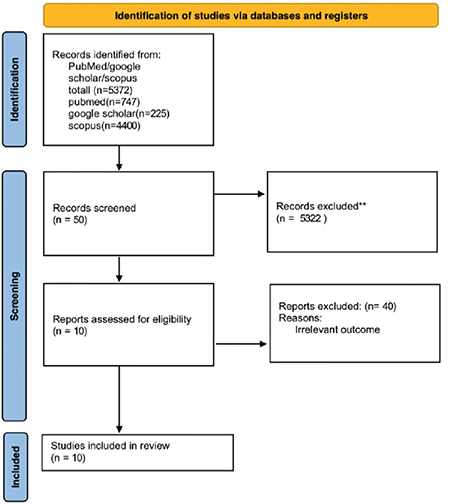
PRISMA: Preferred Reporting Items for Systematic Reviews and Meta-analyses
Table 2. Characteristics of included studies
Author (ref) (year) | Country | Study design | Follow-up duration | Participants (n) | Occupational exposure | Mean age of children | Asthma diagnosis |
|---|---|---|---|---|---|---|---|
Christensen et al.(28) (2011) | Denmark | Cohort study | Last 12 months | Include 45658 children and their mothers. | Maternal occupational exposure/high molecular weight (HMW) Low molecular weight/irritant (LMW)/mixed exposure/student and reference (office workers)/farmers | 7 years old | Used DISC (Danish) International Standard Classification of Occupations) codes. |
Christensen et al.(23) (2013) | Denmark | Cohort study | 18 months | A total of 100,418 pregnancies were enrolled, but only 41,724 mother/child pairs were eligible for analysis in 7-year-old children with an increased likelihood of asthma. | Prenatal maternal occupational exposure/low molecular weight agents early in the child*s life may predispose them to asthma/latex and biocides/fungicides/high molecular weight agents/farmers/students/mixed HMW and LMW agents/Unclassifiable/Reference | 7 years old | Used validated core questions on asthma from the International Study of Asthma and Allergies in Childhood and Asthma Job Exposure Matrix (JEM)18 based on known risk factors for occupational asthma. |
Jøhnk et al.(27) (2020) | Denmark | Cohort study | 5 years | 870 pregnant women provided a fasting spot urine sample for analysis of 12 phthalate metabolites. Finally, 552 mother-child pairs with measurements of phthalate metabolites and information about asthma, eczema, and rhinitis were included. | Prenatal phthalate exposure/Prenatal exposure to DiNP and DEHP | 5 years | Used a questionnaire based on the International Study of Asthma and Allergies in Childhood (ISAAC). |
Magnusson et al.(16) (2006) | Denmark | Prospective cohort study | 14-18 years | 7844 children (4045 boys/3798 girls) from 6418 mothers. | Maternal occupational exposure to organic solvents | 16 | Based on parental report of a physician’s diagnosis via ISAAC questionnaire and hospitalization data |
Pape et al.(30) (2020) | Denmark | Two-generation cohort study | Onset of asthma at 0-15 | 3985 adult offspring ≥18 years of age participating in the (RHINESS) with 2931 of their parents participating in the ECRHS II/RHINE II. | Paternal or maternal occupational exposure to: 1. Microorganisms (molds, endotoxin). 2. Pesticides (herbicides, insecticides, fungicides). 3. Allergens (animals, flour, house dust mites, storage mites, plant mites, enzymes, latex, fish/shellfish). 4. Reactive chemicals (high-level chemical disinfectants, isocyanates, acrylates, epoxy resins, persulfates/henna, aliphatic amines, bleach). | 30 | RHINESSA questionnaire |
Tagiyeva et al.(24) (2010) | United Kingdom | Cohort study | 0-91 months | 13971 | Paternal or maternal occupational exposure to wood, diisocyanate, flour, glues/resins, animals, solders, enzymes, biocides/fungicides, foods, latex and dyes. | Postal questionnaires and clinical assessments (Serum total IgE and allergen skin-prick testing). | |
Tjalvin et al.(31) (2022) | USA | Cohort study | 2 years | Out of a total of 3318 children, 1307 had mothers who had worked for at least 6 months in jobs that involved exposure to indoor cleaning agents. Meanwhile, 150 children had mothers who were exposed to these agents only before conception, while 610 children had mothers who were exposed both before conception and after. Lastly, in 470 children, the mother’s exposure to indoor cleaning agents started after the children were born. | Maternal occupational exposure to indoor cleaning agents (cleaning products/detergents and disinfectants). | 10 years old | Used occupational health tools include ISCO (International Standard Classification of Occupations), JEM (Job-Exposure Matrix), OAsJEM (Occupational Asthma-specific Job-Exposure Matrix), RHINE (Respiratory Health in Northern Europe), and RHINESSA (Respiratory Health In Northern Europe, Spain, and Australia). |
Parker-Lalomio et al.(32) (2018) | USA | Retrospective Cohort study | 800 | Polychlorinated biphenyls (PCBs) | Phone interview | ||
Weselak et al. (2005) | Canada | Cross- sectional cohort study | 3405 children of farm couple (the age of wife was at most 44 years) couples were eligible for inclusion if they were married or living as married, living near-round on a farm operation. Including family-run farms. | Farm couple exposures to any pesticides Fungicides Insecticides Herbicides Other Pesticides Phenoxy Triazine Thiocarbamate Organo-phosphates Dicamba Glyphosate 2,4-DB 2,4-D MCPA Atrazine Cyanazine Carbaryl Captan | Questionnaires were filled based on prior doctor’s visit. |
The analysis results suggest no statistically significant association between maternal occupational exposure to asthmogenic during pregnancy and the development of asthma in children.
Meta-analysis
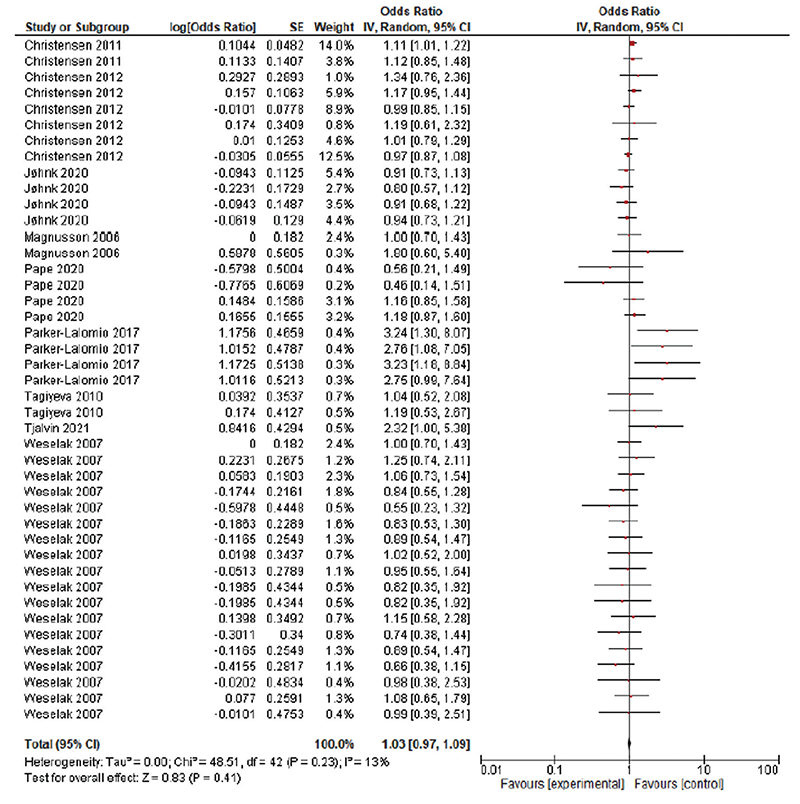
The combined odds ratio for asthmatic children in patients with maternal occupational exposure to asthmogenic during pregnancy was 1.03 (95% CI, 0.97-1.09). The meta-analysis showed moderate statistical heterogeneity with an I of 13%. illustrates the forest plot of the meta-analysis. Sensitivity analyses did not yield significantly different results from the overall analysis.
Publication Bias
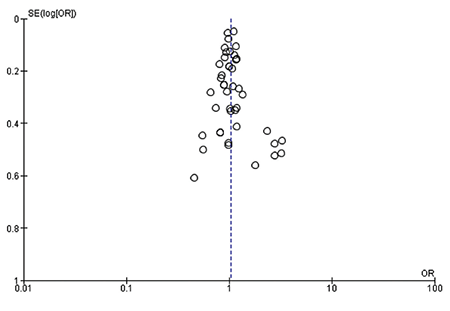
Examination of the funnel plot () did not reveal any indication of publication bias because the graph appeared relatively symmetrical. Furthermore, Egger’s regression test did not show evidence of publication bias (p=0.62).
Discussion
This meta-analysis of nine cohort studies explored the association between maternal occupational exposure to asthmogenic during pregnancy and the risk of asthma in children. These findings did not provide significant evidence of a connection between maternal occupational exposure to asthmogenic during pregnancy and the risk of asthma in children.
Jøhnk et al.() did not find a correlation between prenatal exposure to phthalates and asthma in children. This could be attributed to the lower maternal exposure levels. In addition, the older age of the mothers in the study and their non-smoking status could be contributing factors to the lower prevalence of asthma (7.4%) in these children.
Christensen et al.() found a positive borderline association between maternal occupational exposure to low molecular weight/irritant agents OR = 1.11, 95% CI = (1.01,1.23)] and heavy molecular weight allergens [OR = 1.12, 95% CI = (0.85,1.47)] and asthma in their children.
Christensen et al.() found no association between mothers’ occupational exposures during pregnancy and asthma in their 7-year-old children. Exposure to low molecular weight agents during the postnatal period [OR = 1.13, 95% CI = (0.99, 1.29)] or a combination of prenatal and postnatal exposure [OR = 1.34, 95% CI = (1.19, 1.51)] was linked to a higher prevalence of asthma in children().
Magnusson et al.() found little association between occupational exposure of mothers to organic solvents and asthma in children.
Allergens with high molecular weight can contribute to the development of asthma through immune mechanisms mediated by IgE. In contrast, allergens with low weight, in addition to the above mechanism, may exert a role in asthma development through immunological reactions without IgE or even non-immunological reactions(). Sensitivity to allergens can occur in the uterus without the mother’s sensitivity().
Pape et al.() found a correlation between maternal exposure to allergens and reactive chemicals before and after pregnancy and the development of early-onset asthma in children. Interestingly, no such association was found in men, specifically in relation to their occupational exposures. One possible explanation for this difference could be the increased vulnerability of women’s reproductive cells compared with men’s.
Another study by Tjalvin et al.() demonstrated that Occupational exposure of mothers to indoor cleaning products before and during pregnancy was linked to a higher likelihood of asthma in children [OR = 1.56, 95% CI = (1.05-2.31)]. At the same time, exposure after birth was unrelated to asthma outcomes [OR =1.13, 95% CI = (0.71, 1.80)].
A strong link between occupational exposure to PCBs and childhood asthma was reported [OR = 3.24, 95% CI = (1.30, 8.09)] in the study by Parker-Lalomio et al.().
Tagiyeva et al.() research revealed that exposure to latex and biocides/fungicides in the workplace during pregnancy can increase the chances of childhood wheezing and asthma. The likelihood of childhood wheezing and asthma is further amplified when there are elevated levels of exposure to latex, biocide/fungicide, or a combination of both, with odds ratios of 1.26, 1.22, and 1.22 [95% CI = (1.07, 1.50), (1.02, 2.05), and (1.03, 1.43)], respectively.
Children’s asthma was confirmed in two ways: diagnosis by a doctor or by reporting children’s wheezing episodes by parents. Inaccurate recall of wheezing episodes and differences in access to medical care could bias the results. In addition, some studies did not have access to the family history of allergic diseases. In addition, due to the possibility of mothers suffering from allergic diseases avoiding certain specific occupations, it can lead to incorrect occurrence of negative results.
Conclusion
The current meta-analysis did not reveal any statistically significant association between maternal occupational exposure during pregnancy and the likelihood of asthma in children. Additional cohort and cross-sectional studies are necessary to determine the precise relationship between exposure and asthmogenic during pregnancy and asthma risk in children.
Footnotes
Ethics
Authorship Contributions
Design: P.S.E., M.A.B., Z.M.T., H.P., M.M., B.G., F.S., A.I.P., N.D., M.P., Data Collection or Processing: P.S.E., M.A.B., Z.M.T., H.P., M.M., B.G., F.S., A.I.P., N.D., M.P., Analysis or Interpretation: P.S.E., M.A.B., Z.M.T., H.P., M.M., B.G., F.S., A.I.P., N.D., M.P., Literature Search: P.S.E., M.A.B., Z.M.T., H.P., M.M., B.G., F.S., A.I.P., N.D., M.P., Writing: P.S.E., M.A.B., Z.M.T., H.P., M.M., B.G., F.S., A.I.P., N.D., M.P.
Conflict of Interest: No conflict of interest was declared by the authors.
Financial Disclosure: The authors declared that this study received no financial support.
References
World Health Organization (WHO). Noncommunicable diseases country profiles 2018. 2018.
Karakousis ND, Kotsiou OS, Gourgoulianis KI. Bronchial Asthma and Sarcopenia: An Upcoming Potential Interaction. J Pers Med 2022;12:1556.
Cavkaytar O, Sekerel BE. Baseline management of asthma control. Allergol Immunopathol (Madr) 2014;42:162-8.
Kapri A, Pant S, Gupta N, Paliwal S, Nain S. Asthma History, Current Situation, an Overview of Its Control History, Challenges, and Ongoing Management Programs: An Updated Review. Proc Natl Acad Sci India Sect B Biol Sci 2022:1-13.
McGeachie MJ. Childhood asthma is a risk factor for the development of chronic obstructive pulmonary disease. Curr Opin Allergy Clin Immunol 2017;17:104-9.
Bahna SL. The impact of modernization on allergy and asthma development. Allergy Asthma Proc 2023;44:15-23.
Baldacci S, Maio S, Cerrai S, Sarno G, Baïz N, Simoni M, et al. Allergy and asthma: effects of the exposure to particulate matter and biological allergens. Respir Med 2015;109:1089-104.
Torén K, Blanc PD. Asthma caused by occupational exposures is common - a systematic analysis of estimates of the population-attributable fraction. BMC Pulm Med 2009;9:7.
Baur X, Aasen TB, Burge PS, Heederik D, Henneberger PK, Maestrelli P, et al. The management of work-related asthma guidelines: a broader perspective. Eur Respir Rev 2012;21:125-39.
Hawley B, Cummings KJ, Mohammed M, Dimmock AE, Bascom R. Allergic sinusitis and severe asthma caused by occupational exposure to locust bean gum: case report. Am J Ind Med 2017;60:658-63.
Lummus ZL, Wisnewski AV, Bernstein DI. Pathogenesis and disease mechanisms of occupational asthma. Immunol Allergy Clin North Am 2011;31:699-716, vi.
Bardana Jr EJ. 10. Occupational asthma. J Allergy Clin Immunol 2008;121:S408-S11.
Wright RJ. Prenatal maternal stress and early caregiving experiences: implications for childhood asthma risk. Paediatr Perinat Epidemiol 2007;21(Suppl 3):8-14.
Alati R, Al Mamun A, O’Callaghan M, Najman JM, Williams GM. In utero and postnatal maternal smoking and asthma in adolescence. Epidemiology 2006;17:138-44.
Kilburn KH, Warshaw R, Thornton JC. Asbestos diseases and pulmonary symptoms and signs in shipyard workers and their families in Los Angeles. Arch Intern Med 1986;146:2213-20.
Magnusson LL, Wennborg H, Bonde JP, Olsen J. Wheezing, asthma, hay fever, and atopic eczema in relation to maternal occupations in pregnancy. Occup Environ Med 2006;63:640-6.
McDiarmid MA, Weaver V. Fouling one’s own nest revisited. American Journal of Industrial Medicine 1993;24:1-9.
Salameh P, Baldi I, Brochard P, Raherison C, Abi Saleh B, Salamon R. Respiratory symptoms in children and exposure to pesticides. Eur Respir J 2003;22:507-12.
Kumar S. Occupational exposure associated with reproductive dysfunction. J Occup Health 2004;46:1-19.
Lehmann I, Thoelke A, Rehwagen M, Rolle-Kampczyk U, Schlink U, Schulz R, et al. The influence of maternal exposure to volatile organic compounds on the cytokine secretion profile of neonatal T cells. Environ Toxicol 2002;17:203-10.
Maddox L, Schwartz DA. The pathophysiology of asthma. Annu Rev Med 2002;53:477-98.
Berlin M, Flor-Hirsch H, Kohn E, Brik A, Keidar R, Livne A, et al. Maternal Exposure to Polychlorinated Biphenyls and Asthma, Allergic Rhinitis and Atopic Dermatitis in the Offspring: The Environmental Health Fund Birth Cohort. Front Pharmacol 2022;13:802974.
Christensen BH, Thulstrup AM, Hougaard KS, Skadhauge LR, Hansen KS, Frydenberg M, et al. Maternal occupational exposure to asthmogens during pregnancy and risk of asthma in 7-year-old children: a cohort study. BMJ Open 2013;3:e002401.
Tagiyeva N, Devereux G, Semple S, Sherriff A, Henderson J, Elias P, et al. Parental occupation is a risk factor for childhood wheeze and asthma. Eur Respir J 2010;35:987-93.
Li X, Sundquist K, Sundquist J. Parental occupation and risk of hospitalization for asthma in children and adolescents. J Asthma 2009;46:815-21.
Moher D, Liberati A, Tetzlaff J, Altman DG, The PRISMA Group. Preferred Reporting Items for Systematic Reviews and Meta-Analyses: The PRISMA Statement. PLoS Med 2009;6:e1000097.
Jøhnk C, Høst A, Husby S, Schoeters G, Timmermann CAG, Kyhl HB, et al. Maternal phthalate exposure and asthma, rhinitis and eczema in 552 children aged 5 years; a prospective cohort study. Environ Health 2020;19:32.
Christensen BH, Larsen AD, Skadhauge LR, Thulstrup AM, Hougaard KS, Hansen KS, et al. Mothers work exposure during pregnancy and asthma in their children, a prospective cohort-study. Eur Respiratory Soc 2011;38.
Miller RL, Chew GL, Bell CA, Biedermann SA, Aggarwal M, Kinney PL, et al. Prenatal exposure, maternal sensitization, and sensitization in utero to indoor allergens in an inner-city cohort. Am J Respir Crit Care Med 2001;164:995-1001.
Pape K, Svanes C, Sejbæk CS, Malinovschi A, Benediktsdottir B, Forsberg B, et al. Parental occupational exposure pre- and post-conception and development of asthma in offspring. Int J Epidemol 2020;49:1856-69.
Tjalvin G, Svanes Ø, Igland J, Bertelsen RJ, Benediktsdóttir B, Dharmage S, et al. Maternal preconception occupational exposure to cleaning products and disinfectants and offspring asthma. J Allergy Clin Immunol 2022;149:422-31.e5.
Parker-Lalomio M, McCann K, Piorkowski J, Freels S, Persky VW. Prenatal exposure to polychlorinated biphenyls and asthma, eczema/hay fever, and frequent ear infections. J Asthma 2018;55:1105-15.